


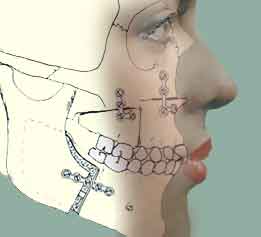
Corrective jaw, or orthognathic, is a surgery performed by the Oral and Maxillofacial Surgeons aimed to correct wide range of skeletal irregularities that cause disharmony in teeth and facial facial appearance; as well as interfering speaking and reduce chewing efficiency, and worst of all, obstruct breathing. Beside enhancing patient’s appearance dramatically, orthognathic surgery is also performed to correct functional problems.
BlogNEWS AND DENTAL EDUCATION
We share informative articles and news.
 We are the Laser Safety Officer qualified to handle the dental laser properly and safely as we have attended the training seminar accredited by the University of Bonn in Germany (A requirement as professional competence according to the European Standard).



Read More…
…What is LASER?

A laser is a device that emits light through a process of optical amplification based on the stimulated emission of electromagnetic radiation. The term “laser” originated as an acronym for Light Amplification by Stimulated Emission of Radiation. Lasers differ from other sources of light because they emit light coherently. Its spatial coherence allows a laser to be focused to a tight spot, and this enables applications like laser cutting and laser lithography. Its spatial coherence also keeps a laser beam collimated over long distances, and this enables laser pointers to work. Laser also have high temporal coherence which allows them to have a very narrow spectrum, i.e., they only emit a single color of light. Their temporal coherence also allows them to emit pulses of light that only last a femtosecond.

Lasers have many important applications. They are used in common consumer devices such as DVD players, laser printers, and barcode scanners. They are used in medicine for laser surgery and various skin treatments, and in industry for cutting and welding materials. They are used in military and law enforcement devices for marking targets and measuring range and speed. Laser lighting displays use laser light as an entertainment medium. Lasers also have many important applications in scientific research. Source: Wikipedia.
This patient came to our clinic complaint that she had a unpleasant smile. After several discussion and consultation, she agreed to have her teeth make over…
![Crowns-veneers-Pre-op02 [1600x1200]](https://prestige-dental-care.com.my/wp-content/uploads/2013/03/Crowns-veneers-Pre-op02-1600x1200.jpg)
![Crowns-veneers-Final05 [1600x1200]](https://prestige-dental-care.com.my/wp-content/uploads/2013/03/Crowns-veneers-Final05-1600x1200.jpg)
…
Matrx Fraser MDM® Mixer

Matrx Fraser MDM® is a unique nitrous oxide/oxygen mechanical mixer which allows easy titration of nitrous oxide levels for quick and effective pain relief.
- Allows titration with tidal volumes as low as 3.2 lpm
- Changes to flow rate do not affect the titration level
- Changes to titration levels do not affect the flow rate
Indications
Nitrous oxide sedation – also called Relative Analgesia(RA) – is indicated for pain relief and management ofanxiety during moderately painful procedures and painful surgery such as:
- Dental surgery
- Emergency medical care
- Obstetrics
- Suturing of superficial wounds
- Reduction of simple fractures
Benefits of Nitrous Oxide Sedation
- Reduced pain and anxiety
- Nitrous Oxide (N2O) has analgesic, anxiolytic as well as mild amnesic properties which make it an excellent agent to reduce patients’ pain and fear.
- Relaxed patients remain fully conscious and responsive
- Rapid onset / rapid recovery
- Clinical effects may begin in less than 30 seconds with peak effects occurring in less than 5 minutes.
- Rapid recovery is achieved after administering 100% oxygen for 5 minutes.
Why choose Fraser MDM® Mixer?
- Allows easy titrationMDM®allows easy incremental titration of nitrous oxide levelsIts unique auto-compensation system eliminates the need to constantly readjust the flowrate and mixture percentage during the titration process.
- Built-in safety features to ensure patient oxygenation MDM®is designed to supply a minimum of 30% oxygen.
- Fail-safe system immediately stops the flow of nitrous oxide if the oxygen supply is discontinued.
- Integrated oxygen flush button immediately increases the flow of oxygen to the reservoir bag by 20 lpm.
- Automatic air intake valve opens to provide ambient air to the patient if the reservoir bag is depleted
- Check valve protects the patient against from re-breathing expired gases.
Read More

elexxion claros@ nano
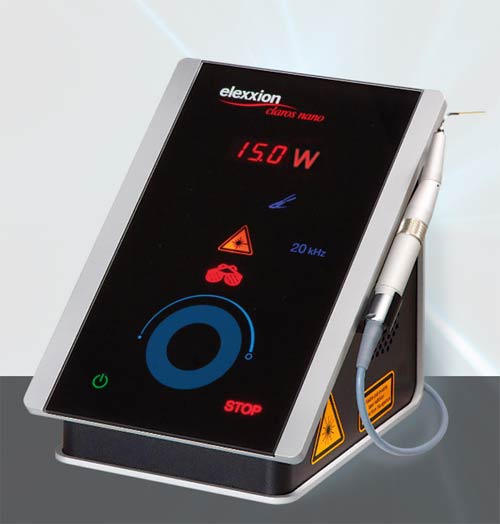 Efficient performance – gentle cutting action – innovative design. That’s what modern diode lasers are all about. The elexxion claros nano is based on the use of superior DPL technology, which opens the way to dozens of soft tissue applications. Painless, efficient and gentle.
The patented pulse technology of the elexxion claros nano combines the benefits of high energy output with the safety and simplicity of a conventional compact diode laser. In addition, the ultra-short pulse duration of 16 μs permits thermal relaxation of target tissue, which keeps undesirable tissue damage to a minimum.
The combination of high output power and extremely short pulses makes it possible to achieve exceptional cutting speed and precision. The patented pulse technology also prevents virtually all tissue carbonization and as a result shortens recovery time.
The wavelength of 810 nm ensures outstanding results in terms of coagulation.
Efficient performance – gentle cutting action – innovative design. That’s what modern diode lasers are all about. The elexxion claros nano is based on the use of superior DPL technology, which opens the way to dozens of soft tissue applications. Painless, efficient and gentle.
The patented pulse technology of the elexxion claros nano combines the benefits of high energy output with the safety and simplicity of a conventional compact diode laser. In addition, the ultra-short pulse duration of 16 μs permits thermal relaxation of target tissue, which keeps undesirable tissue damage to a minimum.
The combination of high output power and extremely short pulses makes it possible to achieve exceptional cutting speed and precision. The patented pulse technology also prevents virtually all tissue carbonization and as a result shortens recovery time.
The wavelength of 810 nm ensures outstanding results in terms of coagulation.
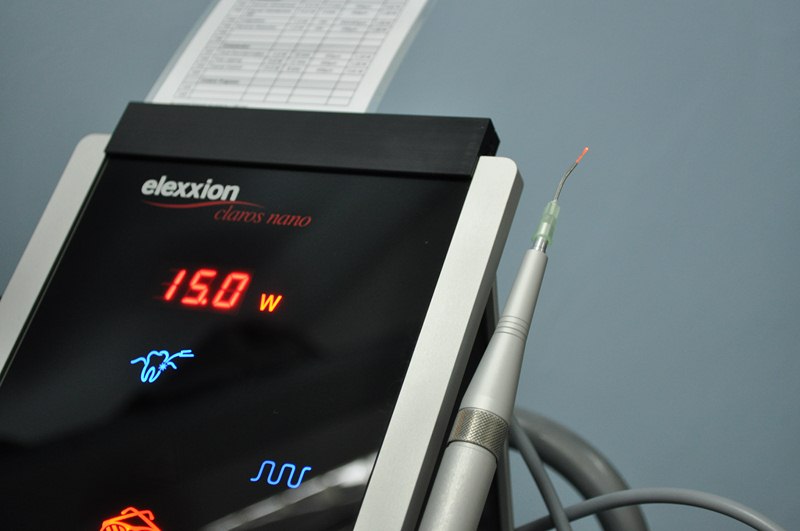
Technical Data
| Wavelength: | 810 nm |
| Energy output: | 0 – 15 W |
| CW operation: | 7 W |
| Repetition rate: | CW – 20.000 Hz |
| Pulse duration: | 16 µs / CW |
| Dimensions: | H 34 cm, B 18 cm, T 20 cm |
| Weight: | 3,7 kg |
| Laser class: | 4 |
| CE 0535 | |
Read More…
… Dental lasers are now being used in all fields of dental disciplines from oral surgery , restorative dentistry in caries removal and tooth preparation , cosmetic dentistry in soft tissue contouring and osseous crown lengthening to periodontology and endodontics in bacterial decontamination and associated surgical treatments. Most recently, researchers are looking into the application of lasers in implant dentistry and treatment of peri-implantitis. …
Laser in Oral Surgery
 Surgical procedures with the diode laser are often bloodless and pain free. These are very desirable attributes for both the dentist and patient. 1. Surgery General – the laser is working at its highest power level 2. Treatment of Abscess – A localized periapical or periodontal abscess 3. Apthous Ulcer Therapy 4. Hemostasis – bleeding following any dental surgery procedure. 5. Curettage – Treatment of advanced periodontal disease 6-10mm. 6. Epulides – Epulis Fissurata all biotypes from granulomatous to giant cell, and fibrous. 7. Irritation Fibroma – Fibromas of the tongue, lip, cheek, and gingiva. 9. Gingivectomy prior to impression or cad cam crown – excess tissue needing removal prior to crown impression, cosmetic recontouring. 10. Granuloma – granulomatous tissue present necessitating removal. 11. Hemangioma – hemangiomas of the lip cheek or tongue as well as blue or venous lake lesions 12. Removal of Hyperplastic tissue – any type of hyperplastic tissue. 13. Bacterial Reduction – any surface area needing reduction of bacteria. 14. Flap surgery – any area requiring a bloodless flap where compromised vascularity is not an issue, for example a split thickness flap for a connective tissue graft is not an area where the laser should be used. 15. Excisional biopsy – any tissue requiring removal that is indicated for a pathology report. 16. Retention cyst – any retained cystic tissue. 17. Exposure of Impacted Teeth – removal of impacted teeth or exposure for orthodontic purposes. 18. Edentulous ridge – removal of excess tissue for preprosthetic surgery. 19. Seeping hemorrhage – areas of persistent bleeding. 20. Sulcus preparation – preparing the sulcus for impressions for crowns or for cad cam images for crowns. 21. Verrucae Lesion – Removal of all Verrucae, wart like and papillomatous lesions. 22. Vestibuloplasty – Ill fitting dentures due to high muscle attachments. 23. Root end rescetion – Failed endodontic treatment needing endodontic surgery (apicoectomy/apicesectomy). …
Laser for Gum Treatment
 The diode wavelengths have desirable characteristics for periodontal therapy because of an excellent bacterial decontamination rate of 99.6% 1. Pocket treatment – periodontally generated pain 2. Gingivectomy – excessive gingiva, sufficient attached tissue and biologic width is needed. 3. Internal bevel incision – swollen gingiva, excessive pocket depth that will not resolve with conservative treatiment. 4. Bacterial reduction – mild to advanced periodontal disease accompanied by bleeding and or bone loss. 5. Decontaminate membranes – any surface which is in need of bacteial decontamination. 6. Open curettage – Pocket depth in excess of 7 mm where access and visualization of calculus for removal is necessasary. 7. Pocket reduction – excessive pocket depth or a need to remodel the gingival architecture to a more favorable state where the attached gingiva is sufficient for removal, ie.the hard palate …
Laser for Endodontic Treatment
 Diode lasers provide excellent bacterial reduction in endodontic canals. The laser offers much better reduction than other means. Investigation of the dentinal tublii shows bacterial contamination up to 1,100μm in depth. Chemical decontamination produces activity up to only 100μm. Diode lasers will produce complete decontamination up to 1,000μm. …
Laser for Teeth Whitening
 A treatment which gets much more famous to every year in aesthetic dentistry is bleaching. …
Laser in Dental Implant

Low Lever Laser Therapy
 The therapy laser (LLLT – low level laser therapy) is a good instrument for a pain reduction, better wound healing and a bio-stimulation. …
Special Laser Therapy – Depigmentation
Pigmented gums or lips can be treated with laser.


Read More…

A young lady had a lower front tooth exacted a few months ago due to tooth decay and she came to us requesting for a permanent replacement of that missing tooth. She didn’t want a denture as it was a removeable appliance. She wanted something fixed in her mouth but wasn’t a bridge as she believe a bridge would damage her neighbour teeth.
Therefore, a dental implant was suggested to her.


After a few months a dental implant tooth was completed and she was quite happy about her implant now.
Below are the process of:
A simple case of Dental Implant Treatment
Below are some of the digital radiography images taken for assessment and consultation prior to surgery removal of wisdom teeth in our clinic
The difficulty of the surgery to removal wisdom teeth are relied on a few factors:
- the position of the wisdom tooth – deep impaction, horizontal impaction would be more difficult than the forward or backward tilt of the wisdom teeth
- the number of roots – the more root a wisdom tooth has, the more difficult it is going to be
- the morphology of wisdom teeth – if the crown is big than surgery will be easier, but if the roots are long, slender and curve then it will be more difficult to be removed as compared to short and fat roots
- near to nearby structure – if the root lies in or very near to the nerve canal in the jaw bone then surgery to remove it has to be very careful not to damage the nerve.
- Other factors: mouth opening, cooperation, the level of anxiety, age
Vertical Impaction of Lower Wisdom Teeth

Left lower wisdom tooth was in vertical position, 2 separated roots. Surgical difficulty – simple.
Right lower wisdom tooth (red arrow) was tilted backward (distally impaction), with 2 separated roots. The distal root curve 90 degree. Surgical difficulty – moderate to difficult.
Realignment of front upper teeth from this….

to this (below) with full porcelain crown…

…
Book an appointment with our doctors now!! Click here
We accept Cash, Credit Card, Grabpay, Alipay, Touch n Go, MayBank QRPAY and Boost
Copyright 2026. All rights reserved.
Get in touchContact us now
If you have any question, don’t hesitate to contact us, we are more than glad to provide you with the information you need!
 :
:  :
: 